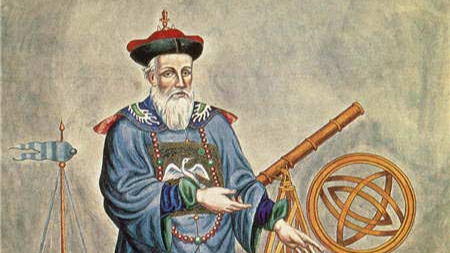
Ferdinand Verbiest
葛兰言
- 分类: 文明交流
- ID: 1862424678311469057
Home CategoryCultural ExchangeFerdinand VerbiestPlay3.5 minsFerdinand Verbiest, born in 1623 in Pittem, Belgium, was a significant Jesuit missionary in China, known as Nan Huairen. He played a crucial role in fostering cultural and scientific exchanges between China and the West during a time of limited external contact, motivated by his faith and dedication to engaging with Chinese culture.ShareCatalogue1. Early Life2. Contributions to Astronomy and Science3. Influence at the Qing Court4. Legacy and Impact
Early Life
Ferdinand Verbiest, known in Chinese as Nan Huairen, was born in 1623 in Pittem, Belgium. He was a prominent figure among the European Jesuit missionaries who traveled to China between the 17th and 19th centuries. Verbiest set out for China in the 17th century, at a time when the Ming Dynasty (1368-1644) had recently fallen, and the Qing Dynasty (1644-1911) was establishing its dominance.
Contributions to Astronomy and Science
In China, Ferdinand Verbiest made significant contributions to the field of astronomy. His expertise in this area was recognized by the Qing imperial court, leading to his appointment as an advisor and a key figure in the reform of the Chinese calendar. Verbiest's work was crucial during a period when accurate calendrical calculations were of paramount importance to both governance and agriculture in China.
Verbiest is credited with designing and supervising the construction of several astronomical instruments at the Beijing Ancient Observatory. This observatory, commissioned in 1442, was a pivotal site for astronomical observation in China. Verbiest's instruments, crafted during the Qing Dynasty, represented a synthesis of Western and Chinese astronomical knowledge. They were used for tasks such as predicting eclipses and other celestial events, which were crucial for the imperial court's legitimacy and decision-making processes.
Influence at the Qing Court
Ferdinand Verbiest became a close advisor to Emperor Kangxi, one of China's most distinguished emperors. His role as a mentor and science teacher to the emperor highlights the deep respect and trust he earned within the Qing court. This relationship was not only based on his scientific talents but also on his ability to navigate the complex political and cultural landscape of the time.
Verbiest's influence at the court was substantial, and he played a critical role in securing the position of Western missionaries within the imperial Astro-Calendric Bureau. This position allowed the Jesuits to continue their scientific and educational missions in China, contributing to cultural exchanges between the East and the West.
Legacy and Impact
Ferdinand Verbiest's legacy extends beyond his scientific achievements. He exemplifies the Jesuit approach of integrating into local cultures while sharing Western knowledge and religious beliefs. His work in China is a testament to the Jesuits' broader strategy of cultural accommodation and intellectual exchange, which facilitated a unique dialogue between different civilizations.
The instruments he designed remain on display at the Beijing Ancient Observatory, serving as a historical testament to the cross-cultural collaborations of the time. Verbiest's contributions to astronomy and his role in the Qing court are celebrated as milestones in the history of Sino-Western relations. Article reference1. An unexpected host for Westerners. chinadaily.com.cn. 20202. Books that speak volumes. chinadaily.com.cn. 20193. Beijing Planetarium. chinaservicesinfo.com. 2018Photo Gallery(2 pictures)CategoriesCultural ExchangeTagCultural EnvoyCatalogue1. Early Life2. Contributions to Astronomy and Science3. Influence at the Qing Court4. Legacy and Impact- - - []








